It’s not only Focolare foundress Chiara Lubich whose centennial birth anniversary is celebrated this year but also that of Saint Pope John Paul II. These two key figures in the Catholic Church during the 20th century were great friends and shared many things in common.
Chiara Lubich was born on January 22, 1920 in Trent, Italy. At a young age amidst World War II, she has committed herself to Gospel-based lifestyle which attracted many to follow her path and years later, without planning it, would give birth to one of the first ecclesial lay movements in the history of the Catholic Church now known as the Focolare Movement.
Born in Wadowice, Poland on May 18, 1920, Karol Jozef Wojtyla (popularly known as Pope John Paul II since his election) became the first non-Italian Pope in more than 400 years in 1978 until his death in 2005, making him one of the longest serving Popes in the history of the Church.
“He had known our Movement already in Karakow, where he was a Cardinal. His attitude was one of complete trust in our charism.”[1]
It was on October 16, 1978 when Pope John Paul II began his pontificate. Chiara recalls,
“Almost at once he wanted to meet me, and on that occasion, he learned, from a map I brought him, about how we are spread in the world. In the more than twenty years that followed…, with great joy, he has come to know of the invasion of our planet by the love we live and which creates unity.”[2]
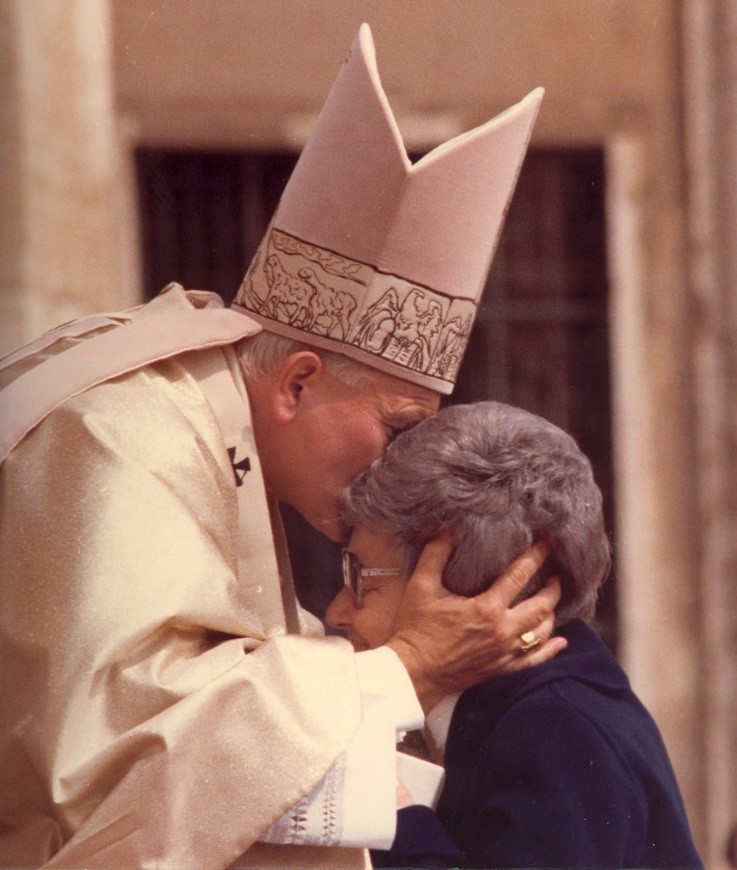
Chiara and John Paul II developed a close friendship with one another over the years. The Holy Father would invite her sometimes for lunch at his home, send her letters on important occasions such as the Feast of St. Claire, grant audiences with her and other members of the Movement, and accept invitations in public events.
These two centenarians share many things in common. We will focus on three – family, youth, and dialogue.
The Vital Role of the Family
Chiara Lubich founded the New Families Movement in 1967. She was very much convinced that the family is a “treasure chest of love”.
Years later from the founding of the New Families Movement, an initiative would come out: the Familyfest. It is a large-scale international meeting held periodically wherein families of various realities, cultures, religions, and backgrounds gather together to share their family life experiences and the projects they are carrying out which offer a testimony to the unity of the one big human family. Chiara told the families present then that, “Our movement must lead the family, all the families it meets to this intent: to revitalize the love that is inherent in every family with that love which is a pure gift of God. So that love may renew love.” [3]
It was in 1981 when the Familyfest was first held in Rome, Italy. In fact, Pope John Paul II was there! Talking to the families present, he improvised when he said, “Your spirituality is open, positive, optimistic, serene and conquering… You have even conquered the Pope… I said that I wish all of you to be Church. Now I want to say that I wish the Church be you.” [4]
(Fun fact: Blessed Chiara Luce Badano, the Focolare Movement’s first member to be beatified, was also in that same meeting! Her participation in this meeting at a very young age was a significant event in her journey towards sanctity as mentioned in biographies and articles written about her life.)
In the same year, John Paul II published a post-synodal apostolic exhortation on the role of the Christian family in the modern world entitled, “Familiaris Consortio” where among many things, he said,
“The future of humanity passes by way of the family. It is therefore indispensable and urgent that every person of good will should endeavor to save and foster the values and requirements of the family.”[5]
Years later, specifically in 1994, Pope John Paul II established the World Meeting of Families to be held every three years since then. The aim is to bring together Catholic families for catechesis, prayer, and to give witness together to the authenticity of family life. But this wouldn’t be the first sign of his particular gaze to the family. At the beginning of his pontificate, he has already dedicated his teachings on marriage, sexuality, and the family. A compilation of this series was later referred to as the “Theology of the Body”.
Great Trust in the Youth
Both Chiara and John Paul II had placed great trust in young people.
In 1973, the first Genfest was held. An intuition of Chiara, the Genfest is a worldwide youth gathering of young people of different cultures and religions who want to commit themselves to contribute to the construction of a more united world.
In 1985, Pope John Paul II called for a World Youth Day which became a regular event since then. It is a meeting of young Catholics with the Pope where participants go in-depth in their young Christian life through catechesis, prayer, and other activities.
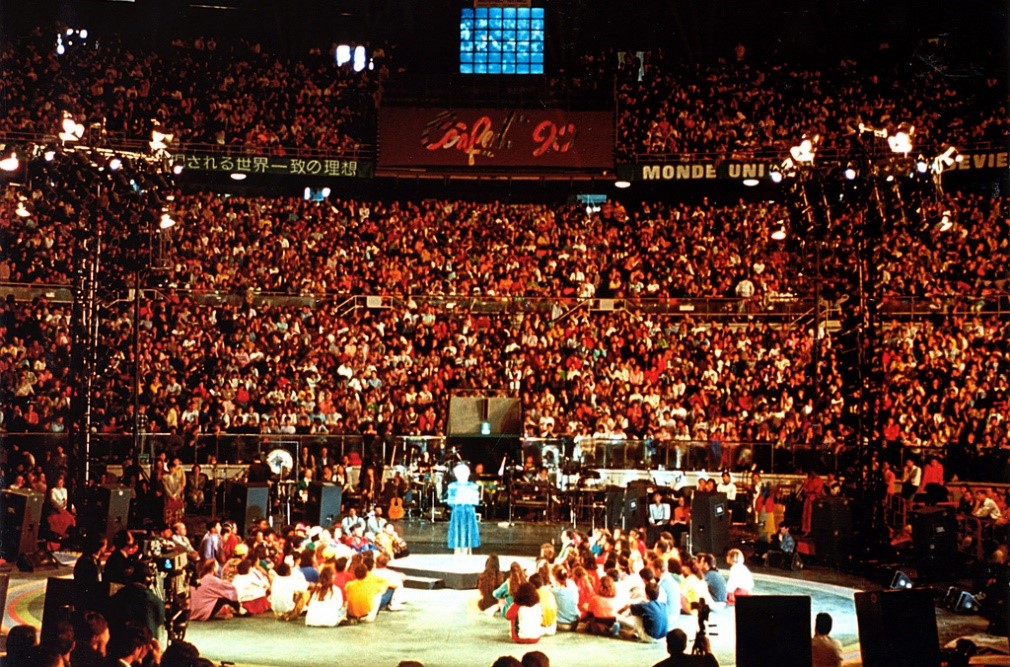
Five years later, in 1990, Pope John Paul II came to the Genfest. Addressing the many young people present then in Rome and those following through radio and television, he expressed his satisfaction in the youth festival and encouraged the youth to continue along the path of working for the unity of the human family.
“My wish is that you too will be able to respond, like the prophets and apostles: ‘Here I am, Lord, send me’. Then you will experience that it is possible to give meaning and concreteness, credibility and implementation to the great values that fascinate man today and forever: peace, freedom, justice, solidarity, development, promotion of every man and every woman. The way of the united world, you know it, passes through Christ…
I wish to encourage your work, the valid educational and formative program of your communities, the charge of fervor that you intend to convey to all the members of the Focolare, the clarity of the Christian ideal that you intend to achieve in your consciences…
Plan your future as apostles of a new world that needs you and your contribution. Tell everyone your optimism, despite the evils and injustices, which you experience every day.”[6]
In Genfest 1995, the Holy Father sent a video message to greet the participants to which he said,
“I am pleased with this fraternal meeting: it is important that young people, although belonging to different cultures and traditions, form a great pilgrimage for the roads of the world, a pilgrimage of peace and reconciliation… Be operators of unity and reconciliation in the ordinary circumstances of life: in the family, in school, at work. And above all pray for unity; each day make Jesus’ prayer your own and let yourselves be guided by his Spirit.” [7]
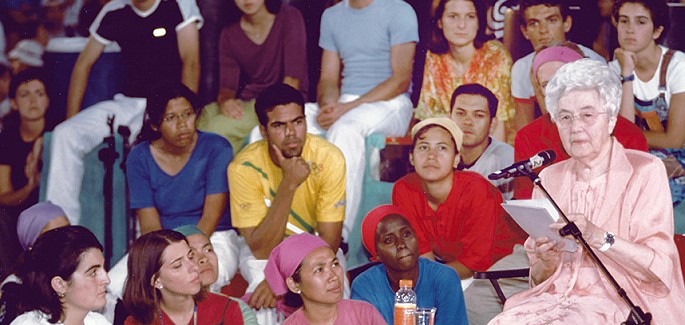
The Genfest that followed was integrated in the program of World Youth Day in the year 2000. In this occasion, Chiara said to the youth,
“Let us love, my dear young people, let us continue to love and the whole world will change. Let us love and contribute toward building the “civilization of love” which our planet awaits, in the midst of tensions, but also in view of the new openness and opportunities of our times. Jesus wants the world to be invaded by love: ‘I have come to set the earth on fire, and how I wish it were already blazing!’ (Lk. 12:49). Let us give him the possibility of seeing it blaze also through our commitment. Then the idea of a more united world, of a united world, towards which many young people are striving today, will not be only a utopia, but it will become, with time, a great and very consoling reality. The future is above all in your hands. With God in our heart, everything is possible. And God certainly wants it!”[8]
An Era of Dialogue

Both John Paul II and Chiara Lubich advocated very much for dialogue. Since the 1960s, Chiara has been engaged in meetings with members and leaders of various Christian denominations (such as the Ecumenical Patriarch of Constantinople) and world religions. Over the years, she was invited over to meet Buddhist monks and their lay members in Asia, Muslims in a mosque in New York, and various Jewish communities. She even instituted a School of Dialogue with Oriental Religions in the Philippines. Later on, she was recognized internationally for her contribution to peace. Chiara once said about dialogue,
“Dialogue – a word especially suited to our times. Dialogue means that people meet together and even though they have different ideas, they speak with serenity and sincere love towards the other person in an effort to find some kind of agreement that can clarify misunderstandings, calm disputes, resolve conflicts, and even at times, eliminate hatred. This dialogue… today is more indispensable than ever if we want to avoid the great evils threatening our societies…
Real, true, heartfelt fraternity is, in fact, the fruit of a love capable of making itself dialogue, relationship, that is, a love that, far from arrogantly closing itself within its own boundaries, opens itself toward others and works together with all people of goodwill in order to build together unity and peace in the world.”[9]
Rev. Dr. Samuel Kobia, General Secretary of the World Council of Churches wrote in 2008, when Chiara passed away, “Chiara Lubich had a profound impact on the ecumenical movement and helped significantly to foster viable relationships between churches of different Christian traditions. (…) Our love for Chiara and immense gratitude for the gift of God she has been to the ecumenical movement will continue to motivate and inspire us in our work for the visible unity of the Church.” [10]
On the 60th anniversary of the Focolare Movement, Pope John Paul II wrote to Chiara, “the members of the Focolare Movement have become apostles of dialogue”. [11]
John Paul II himself made great efforts in the field of dialogue – being the first reigning Pope to visit the United Kingdom to meet the Head of the Church of England (Queen Elizabeth II), being able to establish a strong rapport with the Dalai Lama, being the first Pope to visit a predominantly Eastern Orthodox country since the Great Schism in 1054, being the first Pope to visit a Lutheran church and Lutheran countries. His writings include dialogue as a theme as well.

In 1986, Pope John Paul II started to organize the World Day of Prayer for Peace in Assisi gathering hundreds of religious leaders to pray and fast together for peace. In the same occasion in 2002, Chiara Lubich was asked to give an address in behalf of the Catholic Church.
Dialogue – not only with other Christian denominations, religions, and cultures, but also within the Catholic Church. To celebrate Pentecost 1998, he called for a meeting with various ecclesial movements. Among the participants of this meeting was Chiara Lubich, being the founder of the Focolare Movement. Chiara told John Paul II, “We know that the Church, and you too, desire full communion, unity among the Movements, and this has already begun. We want to assure you, Your Holiness, that, because our specific charism is unity, we will make every effort to contribute, with all our strength, towards fully accomplishing it.”[12] This message corresponded to what the three other leaders of ecclesial communities (the Community of Sant’Egidio, Communion and Liberation, and the Neo-Catechumenal Way) expressed, calling for dialogue and friendship among the movements.
In his message, the Holy Father started with expressing his grateful greetings to Chiara and three others for their testimonies. He continued by encouraging everyone to “Open yourselves docilely to the gifts of the Spirit! Accept gratefully and obediently the charisms which the Spirit never ceases to bestow on us! Do not forget that every charism is given for the common good, that is, for the benefit of the whole Church.”[13]
Continuing their Legacy
Listening to their messages, their work, and their life, I could not help but notice how these two are very much on a similar tune. No wonder, they shared a strong ‘spiritual affinity’[14] as Maria Voice, Chiara’s successor, puts it. They have placed a great deal of attention on the family, youth, and dialogue through their own initiatives and through their collaboration. What better way to celebrate their centennial birth anniversaries than by continuing their legacy? Let’s continue to protect and strengthen the family, to trust and support the youth, and to establish and nurture friendships with people of other Movements, other Christian denominations, other religions, other cultures, and people who do not belong in any religious affiliation – all of these to offer an authentic witness towards the building of a better, more united world.
John Paul II once said to the youth, “It is Jesus who stirs in you the desire to do something great with your lives, the will to follow an ideal, the refusal to allow yourselves to be grounded down by mediocrity, the courage to commit yourselves humbly and patiently to improving yourselves and society, making the world more human and more fraternal.”[15] Let’s take up this encouragement from Pope John Paul II! We know what ideal this is that we want to follow – the ideal of Chiara Lubich, the ideal of a united world. Chiara, herself, assured us, “God will help us in a special way because the ideal of unity is His.”[16]
I have not personally met Chiara and John Paul II. Although while growing up, I saw them on the television and through videos when I was still a kid. I would hear stories from adults, up to now, of their encounters with John Paul II, with Chiara, or for those who didn’t get to meet them, at least how it felt like to live during those times with these two people who have left a mark in human history. How I wish I also had a similar story to tell! Some of us, young people today, belong to the post-John Paul II-and-Chiara era. The story we can work on now is to bring ahead their prophecies. They may be a lot, but as Chiara said, “We have a millennium to see them come true.”[17]
“Do not be afraid”, as John Paul II often said;
“Take courage”, as Chiara often said.
For a united world!
Gio Francisco
May 18, 2020
100th Birth Anniversary of St. Pope John Paul II
[1] The Cry of Jesus Crucified and Forsaken by Chiara Lubich p. 120
[2] The Cry of Jesus Crucified and Forsaken by Chiara Lubich, p. 116
[3] Message of Chiara Lubich to the first Family fest, Rome, Palaeur, May 3, 1981 (https://www.focolare.org/famiglienuove/files/2000/10/FAMILY-AND-LOVE.pdf)
[4] Speech of John Paul II to the married couples participating at the Familyfest qouted from Maria Voce’s Message on the Beatification of John Paul II (https://www.focolare.org/en/news/2011/04/27/beatificazione-di-giovanni-paolo-ii/#_edn9)
[5] Apostolic Exhortation of John Paul II “Familaris Consortio” on the role of the Christian family in the modern world (http://www.vatican.va/content/john-paul-ii/en/apost_exhortations/documents/hf_jp-ii_exh_19811122_familiaris-consortio.html)
[6] Speech of John Paul II on the occasion of Genfest 1990 (https://www.vatican.va/content/john-paul-ii/it/speeches/1990/march/documents/hf_jp-ii_spe_19900331_genfest.html)
[7] Video Message of John Paul II to the participants of Genfest 1995 (http://w2.vatican.va/content/john-paul-ii/it/speeches/1995/may/documents/hf_jp-ii_spe_19950520_genfest.html)
[8] Message of Chiara Lubich to the participants of the Genfest 2000 (https://www.focolare.org/en/news/2000/08/23/intervento-di-chiara-lubich-al-genfest-2000/)
[9] Chiara Lubich’s address at Westminister Central Hall in London published in “Essential Writings” pp. 337 & 341
[10] Rev. Dr. Samuel Kobia’s Tribute to Chiara Lubich (https://www.oikoumene.org/en/press-centre/news/tribute-to-chiara-lubich)
[11] Message of John Paul II to Chiara Lubich on the 60th anniversary of the Focolare Movement (http://www.vatican.va/content/john-paul-ii/en/speeches/2003/december/documents/hf_jp-ii_spe_20031206_chiara-lubich.html)
[12] Speech of Chiara Lubich during Pentecost 1998. Excerpt from the documentary “ON THE WINGS OF THE SPIRIT. Ecclesial Movements: Springtime of the Church” (https://www.focolare.org/en/news/2013/05/14/english-on-the-wings-of-the-spirit-2/)
[13] Speech of John Paul II during the Meeting with Ecclesial Movements and New Communities (http://www.vatican.va/content/john-paul-ii/en/speeches/1998/may/documents/hf_jp-ii_spe_19980530_riflessioni.html)
[14] Message of Maria Voce on the occasion of the Beatification of John Paul II (https://www.focolare.org/en/news/2011/04/27/beatificazione-di-giovanni-paolo-ii/)
[15] Address of John Paul II during the Vigil of Prayer moment at the World Youth Day 2000 (http://www.vatican.va/content/john-paul-ii/en/speeches/2000/jul-sep/documents/hf_jp-ii_spe_20000819_gmg-veglia.html)
[16] Message of Chiara Lubich to the participants of Genfest 1987 (https://centrochiaralubich.org/downloads/chi_19870324_en.pdf)
[17] “I Have A Dream” by Chiara Lubich (https://www.focolare.org/en/news/2018/10/06/chiara-lubich-i-have-a-dream/)